Zero-Click Search in 2026: 68% of Google Searches End Without a Click — And What Still Earns One

September 15, 2026 · 9 min read
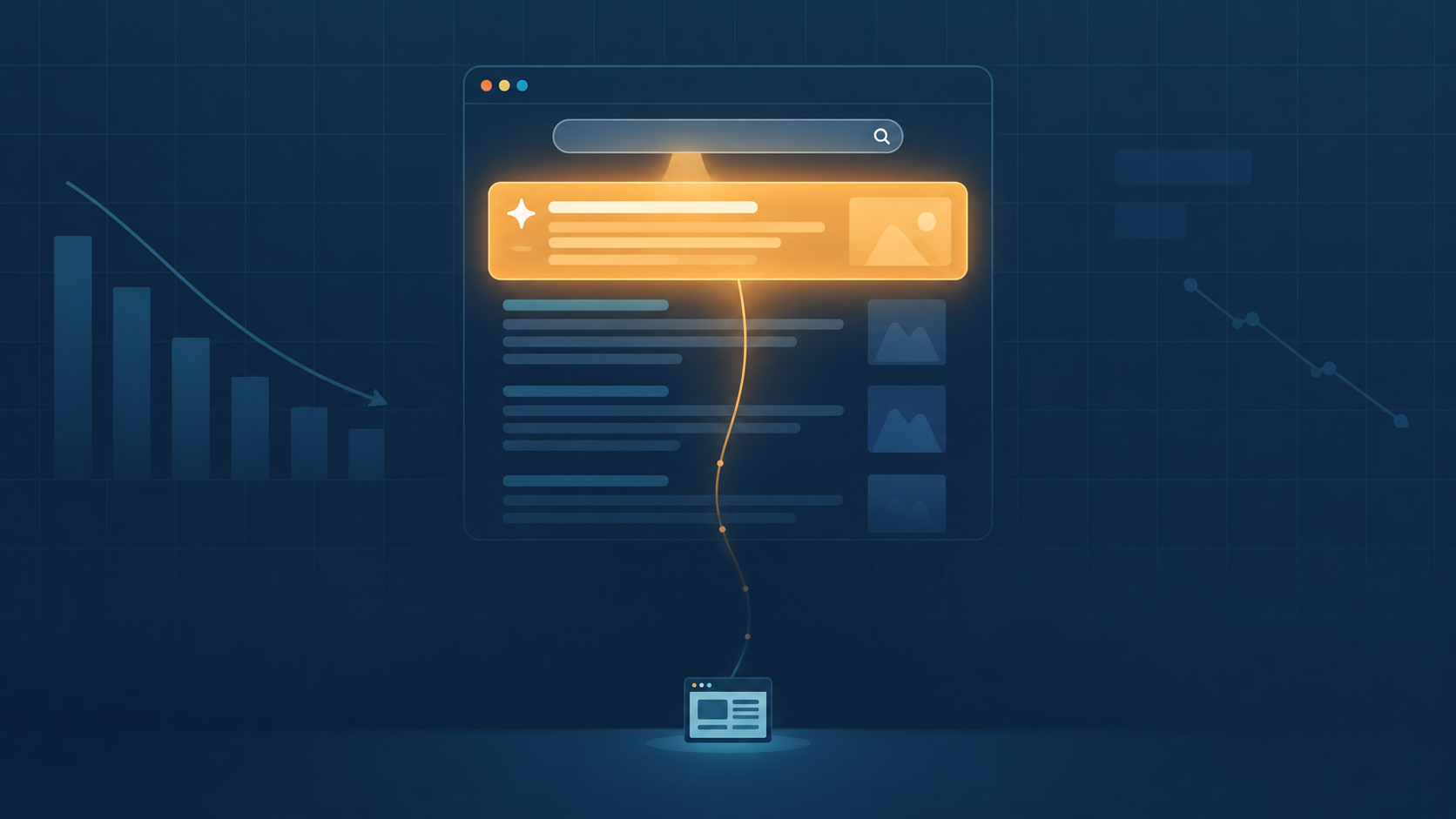
A client emailed me a Search Console screenshot back in March. Subject line was just "is this broken?"
She runs a small HR software company. The keyword was "employee onboarding checklist," the one she'd been chasing since the previous summer. Position 11 to position 3. Impressions up roughly 4x. Clicks went from about 90 a month to 120.
Four times more people saw her. Thirty more showed up.
Her first guess was that the tracking had broken, which is where almost everyone goes. We checked GA4. We checked the tag. We checked whether Search Console was filtering by country, which is the boring answer that's right maybe one time in five. All fine.
The page just doesn't earn the click it would have earned in 2021. Google now answers "employee onboarding checklist" with a bulleted summary before anyone scrolls far enough to see her.
Fourth time I've had that conversation since January. I've stopped opening with "let's check your tracking."
What the 68% actually counts
In June 2026, Rand Fishkin's team at SparkToro went through Similarweb's US clickstream panel for January through April and published the number: 68.01% of US Google searches ended without a click. In 2024 it was 60.45%.
The version of that I'd actually memorise is the one they translate it into. Out of every 1,000 US Google searches, around 276 clicks now reach the open web. Two years ago it was 374.
Before anyone builds a plan on top of that, it's worth knowing what's inside the number. Zero-click here means no click to an outside site and no click to a Google property either, so no Maps, no YouTube. A follow-up search inside Google gets counted separately, and that rose 7.2 points over the same two years, which is its own quiet story. The panel covers US desktop and mobile web only.
The exclusion that matters most is searches made inside Google's mobile app. Those aren't in there. And zero-click behaviour in the app is almost certainly higher, not lower. So the true figure across everything Google owns is probably worse than 68%.
It's also a panel estimate, not a census, and it's US-only. If you're in the UK or Pakistan or anywhere else, treat it as direction rather than measurement.
One more thing I'd want to know if I were reading this somewhere else. SparkToro sells audience research software and Fishkin wrote a book about zero-click marketing. That doesn't make the data wrong , Similarweb's panel is the panel, and Search Engine Land and a dozen others reported the same figures off the same study. But you should know who's holding the microphone when a number this convenient shows up.
None of this started with AI Overviews
Fishkin first measured zero-click in 2016 and it sat around 45%. By 2019 it was near 49%, which is the year the phrase got into everyone's vocabulary. Featured snippets, knowledge panels, People Also Ask , those had been quietly absorbing clicks for the better part of a decade before generative AI turned up anywhere. By 2024 the Datos clickstream data, and Datos is part of Semrush now, put the US figure at 60.45%.
Then AI Overviews scaled properly and it went 60.45 to 68.01 in two years. Steepest two-year move SparkToro has recorded since they started counting.
Google has been trying to answer your question on the results page rather than send you elsewhere since around 2012. What changed recently is how good it got at it, not that it started.
Small thing worth filing away for planning: AI Mode, the conversational search everyone spent last year panicking about, was 0.34% of searches during the study window. Basically nothing. But Google said at I/O this year that AI Mode had passed a billion monthly users with query volume more than doubling each quarter. So 0.34% is a starting line.
The clicks that survive are worth less
Pew Research tracked 900 US adults across 68,879 Google searches in March 2025 and published it that July. When no AI summary appeared, people clicked a traditional result in 15% of visits. When one appeared, 8%.
Roughly half. That's the stat everyone quotes.
The one nobody quotes is better. Users clicked a link inside the AI summary in about 1% of visits.
Sit with that if you write content for a living. The citation footer , the thing Google added partly because publishers complained , is almost never touched. Being cited inside an AI Overview is worth something. It is not worth a click. It's worth a brand impression, which is a different asset with a much slower payback and no line in your analytics.
Pew also found people were more likely to end the session entirely after a page with a summary, 26% versus 16% without. So the summary doesn't only redirect the click. Sometimes it ends the trip.
For scale: AI Overviews now show on more than a fifth of all searches, and Ahrefs research cited inside the SparkToro study put the CTR drop at around 60% when one appears.
Where the damage lands and where it doesn't
68% is an average and averages bury the useful part.
Pew's data on what triggers a summary is the clearest planning signal I've seen. Question-shaped searches — who, what, why — produced one 60% of the time. One and two-word searches, 8%. Ten words or more, 53%.
Longer, more conversational, more question-like. Those are the ones Google feels confident handling alone.
Which means if your content plan has spent five years on "what is," "how does" and "why do," that is exactly the shape Google now takes for itself. Transactional queries hold up better. Pricing, near me, X vs Y. Google still needs somebody to click through and eventually spend money.
That split tells you more about your own site than the headline number does.
Who's already felt it
Business Insider lost more than half its organic search traffic between 2022 and 2025 and cut 21% of staff. HuffPost's search referrals fell by something similar over a similar stretch. The Verge, which has an actual newsroom and actual resources, saw a decline its publisher Helen Havlak has said lined up closely with AI Overviews rolling out.
I've seen much uglier numbers than those floating around for Digital Trends and ZDNet — 97%, 90%, that sort of thing. I've left them out. They trace back to third-party Ahrefs estimates rather than anyone's own analytics, and third-party traffic estimates for individual domains are directionally interesting and precisely unreliable. Three numbers you can check beats seven you can't.
The finding in SparkToro's data I found hardest to read was about size. Smaller publishers took the sharper hit. The largest sites held up better. Scale helps. It doesn't rescue anyone.
Is SEO dead? No, but one half came unstuck from the other
"SEO is dead" is a great headline and a useless sentence for anyone actually running a business.
Fishkin's own framing is narrower and the narrowness is the point. It isn't that SEO stopped working. It's that getting better at the old version of SEO stopped being enough on its own to produce traffic. Two different claims.
What's happened is one job became two.
First is visibility. Ranking, showing up, being the source an AI Overview or ChatGPT cites. Still worth having, because it's still how a lot of people form an impression of a company before they ever type its name in directly. Somebody reads about you inside an AI Overview, doesn't click, searches your brand name nine days later. That visit lands in your analytics as direct or branded. You earned it in the first search. Your tools will credit the second.
Second is earning whatever's left of the click. The roughly 32% that still produce one lean toward searches where a person needs to end up somewhere. A comparison to weigh, a price to check, a decision a summary can't close for them.
Writing generic explainers and expecting 2015 traffic is the part that died. The rest is adjustment.
What changed in how I work
No five-step framework here. This is just what's different from eighteen months ago.
Flat sessions stopped being automatic proof that something failed. Rankings climb, traffic doesn't, that used to mean broken tracking. Now it can just as easily mean you won visibility and lost the click, and those need completely different fixes. Branded search volume, direct traffic and assisted conversions carry more weight in that conversation than they did. I report impressions and average position next to clicks now, not underneath them in a section nobody reads.
I chase queries a summary can't resolve. Pricing comparisons, "which of these fits my situation," anything needing an opinion or a transaction. Pew's trigger data is a rough proxy, if you can phrase your target keyword as a plain question, assume Google will answer it for you.
I write to be the source rather than to rank. AI Overviews pull from content that answers cleanly near the top and then goes deeper, not content that buries the answer under three paragraphs of preamble. Padded posts get skipped even when they outrank something better, which is its own kind of justice.
I tell clients some content isn't worth producing anymore. A 2,000-word explainer for a definitional query Google now answers in three sentences won't earn back the hours. That budget moves to the harder, more opinionated work. Clients don't always love hearing it.
And building something outside Google stopped being a backup plan. Every publisher in those case studies that held up had a direct line to its audience that didn't run through a Google click. Usually an email list. Sometimes just enough brand recall that people type the URL from memory.
I should be honest about the limits of all that. I've been running it about a year. Branded search is up across most of the accounts I've moved this way. I don't have enough accounts, or enough time, to tell you that's causation rather than a decent guess that happens to be working.
Where that leaves things
Search isn't shrinking. Google is handling more queries than it ever has. What's gone is the assumption that ranking well produces a visit, and for fifteen years those were effectively the same thing.
They aren't now. Treating them like they still are is how you end up with a rankings report that looks great sitting next to a traffic graph that doesn't.
Nobody's solved this, me included. But the accounts handling it best aren't the ones trying to claw back 2019's click-through rates. They stopped trying and started building something the click-through rate doesn't get a vote on.
Sources
SparkToro and Similarweb zero-click study, June 2026: https://sparktoro.com/blog/in-2026-less-than-one-third-of-google-searches-still-send-a-click/
Search Engine Land coverage of the same study: https://searchengineland.com/google-zero-click-searches-2026-study-479717
Pew Research Center, AI summaries and click behaviour, July 2025: https://www.pewresearch.org/short-reads/2025/07/22/google-users-are-less-likely-to-click-on-links-when-an-ai-summary-appears-in-the-results/
About the author
Ali Asghar has worked in SEO since 2024 and currently handles organic search for 10+ client accounts at GitzStdio, mostly B2B software and local service businesses.
Frequently asked questions
More to read
What Is Digital Marketing? A Complete Beginner's Guide
Digital marketing is basically about getting people to notice and buy things online, rather than relying on TV ads, newspapers, or billboards. But there’s more to it than that. Here’s what digital marketing actually includes and where you can start if you’re completely new to it.
$ published Sep 17, 2026 · 9 min read · #content-marketing #search-rankings
Malik Asghar
Dario Amodei's "Pace the Frontier": What Anthropic's CEO Actually Said About Slowing AI Down
Anthropic CEO Dario Amodei says frontier AI development needs to slow down. Here's what "pacing the frontier" means, why he changed his mind, and how Altman, Musk and Hassabis responded.
$ published Sep 15, 2026 · 19 min read · #ai #dario #anthropic
 Hanzla Baig