You Have 500 Email Subscribers and Zero Sales. Here's the Fix.

October 21, 2026 · 8 min read
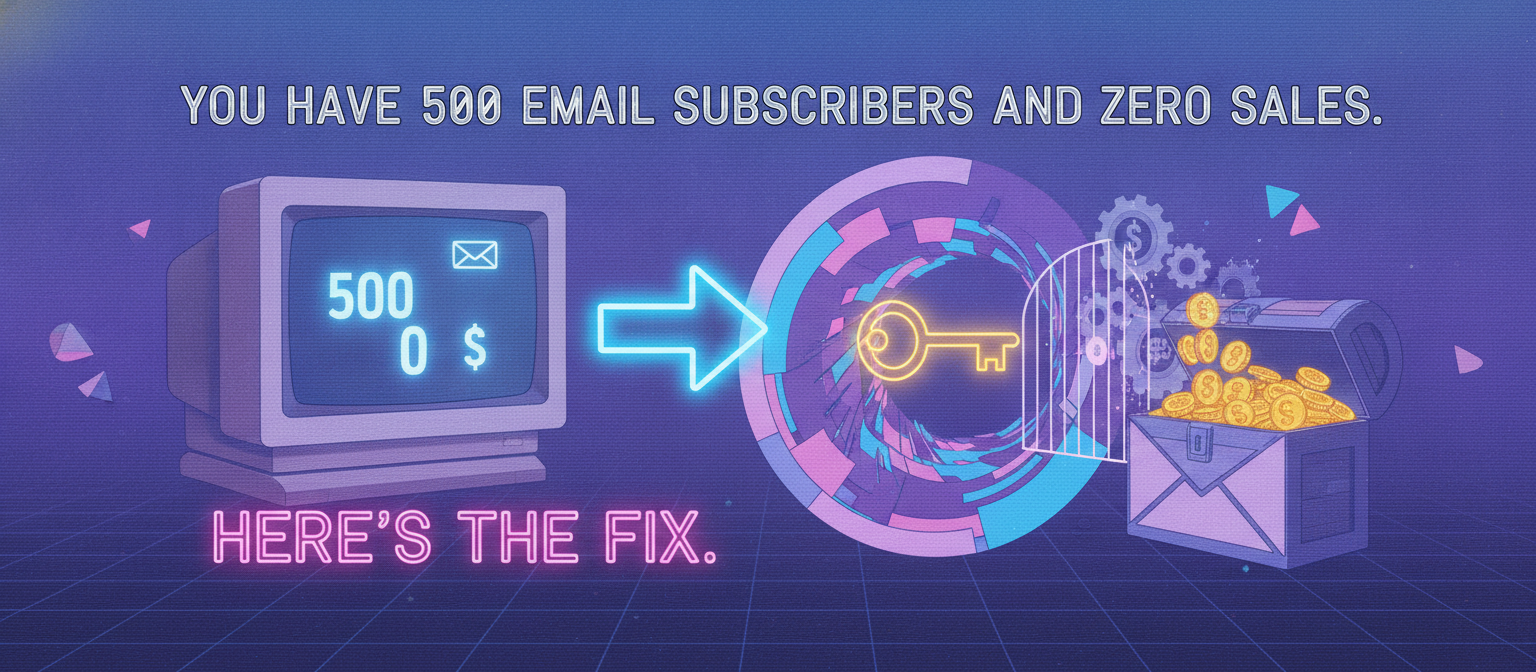
Five hundred subscribers and one launch email later, you've got decent opens, a few clicks, and exactly zero sales. That's a weird, kind of deflating place to be. The list isn't small. People did sign up. So why didn't anyone buy?
Honestly, it's almost never the product. It's usually one of three boring things: who's actually on the list, what you sent them, or when you sent it. None of that is exciting to hear, but it's fixable, and it's fixable without doubling your subscriber count.
First, figure out which problem you actually have
Before changing anything, sit with your own list for ten minutes and be honest about it.
Did you build this list around a loosely related freebie, something like "10 tips for X" that could've come from any site in your niche? If people signed up mostly for a discount or a generic download, you didn't collect buyers. You collected email addresses. There's a difference, and it matters more than most people want to admit.
Did you pitch too soon? A lot of founders deliver the lead magnet and then, an email or two later, go straight for the ask. It's not a dumb move exactly, it just skips a step. Nobody buys from someone they haven't learned to trust yet, and one or two emails isn't enough time to build that.
Do your emails look like a company sent them? Big banner image up top, "Dear Valued Subscriber," three columns of links. People's inboxes have learned to tune that out fast. Doesn't mean design is evil, just means it's worth testing something plainer.
And are you sending the exact same email to everyone? Someone who's used your product every day this week and someone who signed up and vanished are not the same person. Treating them the same is probably the single easiest thing to fix, because it doesn't need new content, just better targeting of what you've already written.
If two or three of these sound familiar, that's fine, that's normal. Work through them in roughly this order, but trust your own data more than any article telling you what order to do things in.
Start with the opt-in, not the emails
Here's a question worth sitting with: if someone grabbed your lead magnet right now, would they be mildly annoyed to then get an email pitching your actual product? If yes, that's a signal the magnet's attracting the wrong crowd.
That said, a mismatch doesn't always mean the magnet itself is broken. Sometimes it just means the person's early, they recognize the problem but aren't ready to act on it yet. That's what the welcome sequence further down is for.
A few opt-ins that tend to do better for SaaS and tool products, with a real-ish example for each:
A stripped-down free version of the actual product. If you're building a website uptime monitor, give away a one-time free report on someone's last seven days of downtime instead of a generic business-growth PDF.
A narrow guide for the exact moment right before someone needs you. A project management tool might offer "what to do in the first 48 hours after a client misses a deadline" instead of a broad productivity guide nobody asked for.
A waitlist or early access tied directly to the product. This one filters itself, people only join if they're already curious about what you're building.
If your current opt-in doesn't look anything like these, it's worth swapping. Just don't judge the swap by subscriber count. Judge it by trial starts and paid conversions a few weeks later. A tighter opt-in usually brings in fewer people, and that's not a failure, that's the point.
Write the welcome sequence before you ever write a newsletter
If you're early-stage, a welcome sequence is almost always a better use of an afternoon than a recurring newsletter. You write it once. It fires on its own for every new subscriber from now on. And it gets to speak directly to whatever decision that person is facing right when they join, not whatever happened to be on your mind that week.
A structure that's worked well, roughly:
Email 1, right away. Deliver whatever you promised. Say who you are in a couple sentences. Don't pitch anything yet.
Email 2, a day or two later. The problem, but told through something specific. A real customer, or your own run-in with the issue, beats a generic list of pain points every time. Don't have a real example handy? Say that, plainly, or label it clearly as a made-up scenario. People can tell the difference, and pretending otherwise costs you more trust than it's worth.
Email 3, two or three days after that. Show the fix. A quick walkthrough, a screenshot with plain text under it, something concrete. Drop in a low-pressure link to try it.
Email 4. Hit the one or two real objections people actually raise, price, switching cost, time, whatever it is, head-on, no spin.
Email 5. This is the only email allowed to flat-out ask for the sale. Pair it with a reason to act that's actually true, a real onboarding slot, a real demo date, pricing that's genuinely about to shift. Not a fake countdown timer that resets the second someone refreshes the page.
Here's roughly what email 3 could look like, written out instead of just described:
Subject: here's what it looks like, under 2 minutes
Hey [name],
Quick follow-up from yesterday, here's what it actually looks like once it's set up: [screenshot or short walkthrough].
Most people get their first result in under two minutes. No call, no setup spreadsheet.
Want to try it on your own stuff? [link]
[your name]
The theory is this gives people context before you ask them for anything, which usually beats a cold pitch. But don't take that as gospel. Track your own trial-start and reply numbers per email and see what your audience actually does, not what some article says they'll do.
Sound like a person, because you are one
Send from a name and an inbox someone can actually reply to. Not no-reply@. A shared team inbox is fine, as long as a real human answers it. The point is being reachable, not the exact format of the address.
Plain, conversational subject lines tend to outperform the "🚀 Unlock Growth Now" kind, but don't just trust that, test it if you've got the volume. Run something specific against something generic and judge it by clicks and conversions, not opens. Open tracking's gotten noisy anyway, Apple Mail Privacy Protection pre-fetches messages now, so a good-looking open rate doesn't always mean a human actually read it.
And reply to people. Seriously. It's worth doing even before you know whether it moves the needle on sales, because it shows you what's actually confusing or missing about your product in a way no automated sequence ever will.
Stop sending everyone the same email
Once the welcome sequence exists, split the list by what people have actually done, not when they joined. A few honest notes as you set this up:
Never opened a single email. Worth a short win-back attempt, but check your tracking first. Plenty of email clients block open-tracking by default, so "never opened" isn't always true, it might just be unmeasured.
Clicked something but never signed up. A click on a real feature or demo is a stronger signal than an open. A personal check-in makes sense here, though that only scales to a few hundred people realistically. Past that, write one good templated email instead.
Signed up but never really used it. Pin down what "activated" actually means for your product before building anything here. For an analytics tool that might be "installed the script, viewed one report." For a project tool, "created a project, invited someone." A fuzzy "used the product" tag won't tell you much when you go to act on it.
Active but hasn't paid. Worth a direct offer, but don't assume every free user is about to convert. Some are genuinely happy staying free forever, and that's fine. Someone hitting a usage limit repeatedly or checking your pricing page more than once is a much stronger buy signal than activity alone.
Most mainstream email tools support basic tagging and triggered sends on their free tiers, but features and limits shift around a fair bit, so check the current pricing page before you plan a whole system around something being free.
Figure out if any of this is actually working
I'm not going to hand you a made-up "typical open rate" here, because it genuinely varies too much by industry, audience, and list quality to be useful, and pretending otherwise would just be noise. Instead, write down your own baseline before changing anything:
Subscriber count and growth rate right now
Click-through rate on your last few sends, not just opens
Trial starts you can actually trace back to an email
Activation rate among those trials, using your own definition
Paid conversions you can tie to an email touch
Make the changes above, keep the list roughly the same size, and check those five numbers again in a month. Clicks and trials moving but paid conversions not? The problem probably shifted from your list to your onboarding. Nothing moving at all? Time to look harder at who's actually on the list.
This week, in order
Look at your current opt-in. Swap it if it's generic.
Write the five-email sequence. Keep each one under 150 words.
Fix your sender name. Strip the template down.
Decide what "activated" actually means for your product, then tag people by it.
Write down your five baseline numbers today. Check them again in a month.
A list that won't convert usually isn't dead. It's just unsorted. Fixing who's on it, what the first few emails say, and whether different people get different messages beats assuming email doesn't work for you, almost every time.
For the rest of the marketing stack, SEO, content, paid ads, see Digital Marketing for Small Businesses on a Tight Budget.
Frequently asked questions
More to read

NVIDIA Has Put Thousands of 3D Assets on Hugging Face. The Interesting Part Is What You Can Do With Them
NVIDIA's SimReady Assets collection brings thousands of simulation-ready 3D models to Hugging Face. Explore what's included, how OpenUSD works, and how developers can use these assets in robotics, digital twins, and custom 3D environments.
$ published Oct 29, 2026 · 8 min read · #openusd #hugging-face #robotics #nvidia-simready #3d-assets
 Hanzla Baig

Best Financial Data APIs for Developers (2027): Tested and Compared
Compare the best financial data APIs for developers in 2027. Explore free plans, pricing, rate limits, stock market data, financial statements, licensing, and AI integrations to find the right API for your project.
$ published Oct 27, 2026 · 18 min read · #stockmarket #financialdata #webdev #api #mcp
Hanzla Baig