Why Your Loan, Your Savings and Your Grocery Bill All Quietly Depend on One Number From the State Bank

October 24, 2026 · 8 min read
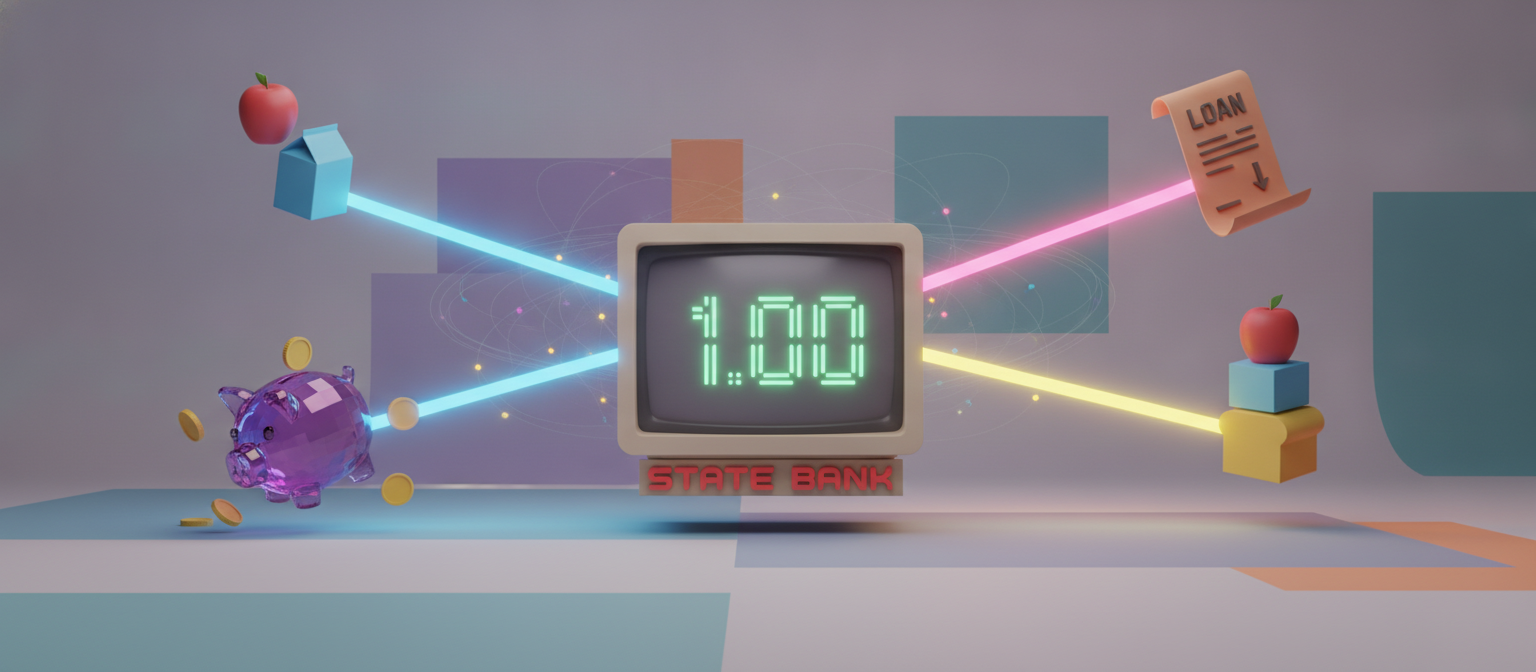
Every few weeks the news does the same thing. A presenter says the State Bank has "kept the policy rate unchanged," or raised it by 50 basis points, a number flashes on the screen, and most of us reach for the remote. It sounds like something meant for bankers and economists.
It isn't. That one number sits behind the instalment on a car loan, the profit your savings account pays, and, a bit more slowly, what you pay for flour and petrol. This article walks through how that works, using the real figures as they stand on 23 October 2026.
So what is the policy rate?
The policy rate is the State Bank of Pakistan's benchmark interest rate. Its Monetary Policy Committee (MPC), ten members, sets it at meetings on a published calendar. Think of it as the base price of money for the whole banking system. Right now it is 11.5%.
The SBP also fences that number in with a band called the interest rate corridor. The top of the band, 12.5%, is what a bank pays to borrow overnight from the State Bank. The bottom, 10.5%, is what a bank earns when it parks spare cash there. The policy rate sits in the middle.
You never borrow from the State Bank, of course. But your bank's own cost of money starts from that band, so the loan you take and the savings account you hold are both priced with that number somewhere in the background. When it moves, bank rates follow, usually over weeks and months rather than overnight.
How it reaches your loan
Most variable-rate loans in Pakistan are priced as KIBOR plus a margin. KIBOR is the Karachi Interbank Offered Rate, basically the rate at which banks lend to each other, and it tracks the direction of the policy rate and what the market expects it to do next. In mid-October the six-month KIBOR was around 12.43%, already above the policy rate, because the market is leaning toward an increase.
Here is what a small change looks like in rupees. This is a made-up example, not any bank's offer. Say you borrow Rs 2,000,000 over five years at 15%. Your monthly instalment comes to roughly Rs 47,580.
If the rate rises to 15.5%, the instalment becomes about Rs 48,106. That is Rs 527 more every month, or around Rs 31,600 extra over the five years. A full one percentage point (16%) adds about Rs 1,056 a month, which is roughly Rs 63,400 in total.
Those figures use a standard reducing-balance calculation and are rounded, so your bank's numbers will differ a little. The point is the shape: a move that looks tiny on television is a real amount on a household budget.
One catch. Not every loan floats. If your loan has a fixed rate, a policy change doesn't touch your instalment until the fixed period ends. Your agreement will say which kind you have, and it is worth a few minutes to find out before the next announcement.
How it reaches your savings
The other side of the coin is the profit on your savings account. Since 1 August 2026, the State Bank's minimum profit rule applies to individual savers whose average monthly balance is up to Rs 10 million. Above that, banks are free to pay what they like. According to Allied Bank's explainer on the rule, the minimum sits 50 basis points below the corridor's floor of 10.5%, which works out to 10.00% a year today. Bank rate sheets show the same thing. Soneri Bank's savings accounts, for example, list 10.00%.
So Rs 500,000 in an ordinary savings account earns about Rs 50,000 over a year, before tax.
Now put inflation next to it. In September 2026, prices were 10.3% higher than a year earlier, according to the Pakistan Bureau of Statistics. If prices keep moving at that pace, something that costs Rs 500,000 today costs about Rs 551,500 a year from now. Your Rs 500,000 has become Rs 550,000, and that's before tax takes its small bite. You have more rupees but slightly less buying power.
Economists call this the real return: the interest you earn minus the inflation you pay. When the policy rate is only a little higher than inflation, the real return is thin. When it is lower, savers lose ground. That is why the State Bank talks about keeping real interest rates "positive," and why the gap between 11.5% and 10.3% gets so much attention.
And the grocery bill?
This is the part that confuses people. Prices have been rising because of oil and wheat. Raising interest rates doesn't make a single extra wheat stalk grow. So why does the State Bank bother?
Because its job is to stop a one-time jump from turning into a habit. When fuel gets expensive, transport costs go up, then food costs go up, then workers ask for more pay, then shops raise prices again because they expect everyone else to. Higher interest rates make borrowing and spending a bit less attractive, which cools demand and takes some heat out of that loop. It works with a delay, usually many months, and it can't fix a supply shortage. It only keeps the damage from spreading.
The State Bank said much the same in its 14 September statement. The MPC pointed to the Middle East conflict pushing global energy prices higher, to food inflation driven by wheat, and to a rise in the inflation expectations of both businesses and consumers. Its stated aim is to bring inflation back to 5-7% over the medium term.
The recent path has been bumpy. According to the data reported by the SBP and PBS, headline inflation went from 7.3% in March to 10.9% in April and 11.7% in May. It eased to 11.1% in June, dropped to 9.2% in July, jumped back to 11.1% in August, and came in at 10.3% in September. A year earlier, in September 2025, it was 5.8%. Wholesale prices rose 13.3% in September, faster than consumer prices, and analysts watch that gap because it can feed through to shop shelves later.
How we got to 11.5%
A short history helps. The policy rate peaked at 22% before the State Bank started cutting. By 15 December 2025 it had come down to 10.5% after a 50 basis point cut, and the MPC held it there on 26 January 2026.
Then oil prices jumped after the Middle East conflict escalated, and inflation, which had been calm, picked up fast. On 27 April 2026 the SBP raised the rate by 100 basis points to 11.5%. It has held there at each meeting since: 15 June, 27 July and 14 September. The September decision was not unanimous. Seven of the ten members voted to hold.
What happens on 26 October
The MPC meets again on Monday 26 October, its seventh meeting of 2026. Nobody outside the room knows the result, but there is a useful clue. In a survey of market participants by Topline Securities, 61% expected an increase, 54% of them by 50 basis points and 7% by a full 100. The other 39% expected no change. Topline's own forecast is a 50 basis point rise to 12%.
Treat that as the market's guess, not as news. The committee can, and sometimes does, surprise people. If you read this after the meeting, check the State Bank's website for the actual decision.
Either way, you can run the arithmetic from earlier. A half-point rise adds roughly Rs 527 a month to a Rs 2,000,000, five-year loan at the example rates. It also nudges up what new savings products can pay.
What a regular person can do with all this
Nothing here is investment advice, and your situation is your own. But a few ordinary habits make this number easier to live with.
Find out whether your loan is fixed or floating. Look at your bank's current savings rate sheet and set it next to the latest inflation figure, so you know whether your money is gaining or losing ground. If you are planning a house or car loan, calculate the monthly instalment at two or three different rates before you sign, because the cheap-looking offer today can look different after the next meeting. And try not to read one announcement as a trend. Rates move in cycles that last months, and one meeting rarely tells the whole story.
The policy rate is one of those things that looks distant until you notice how many parts of your month it touches. Once you can see the line from that single percentage to your instalment, your profit statement and your shopping bill, the headlines stop sounding like noise.
This article is for general information only and isn't financial advice. Rates, inflation figures and MPC dates change, so check the State Bank of Pakistan and your own bank for current numbers. Figures in this article are as of 23 October 2026.
Frequently asked questions
More to read

NVIDIA Has Put Thousands of 3D Assets on Hugging Face. The Interesting Part Is What You Can Do With Them
NVIDIA's SimReady Assets collection brings thousands of simulation-ready 3D models to Hugging Face. Explore what's included, how OpenUSD works, and how developers can use these assets in robotics, digital twins, and custom 3D environments.
$ published Oct 29, 2026 · 8 min read · #openusd #hugging-face #robotics #nvidia-simready #3d-assets
 Hanzla Baig
Best Financial Data APIs for Developers (2027): Tested and Compared
Compare the best financial data APIs for developers in 2027. Explore free plans, pricing, rate limits, stock market data, financial statements, licensing, and AI integrations to find the right API for your project.
$ published Oct 27, 2026 · 18 min read · #stockmarket #financialdata #webdev #api #mcp
Hanzla Baig