The Jacket Is Not the Man: What Jensen Huang's Fall Reveals About Power, Mockery, and the Myth of the Indispensable Founder

November 12, 2026 · 14 min read
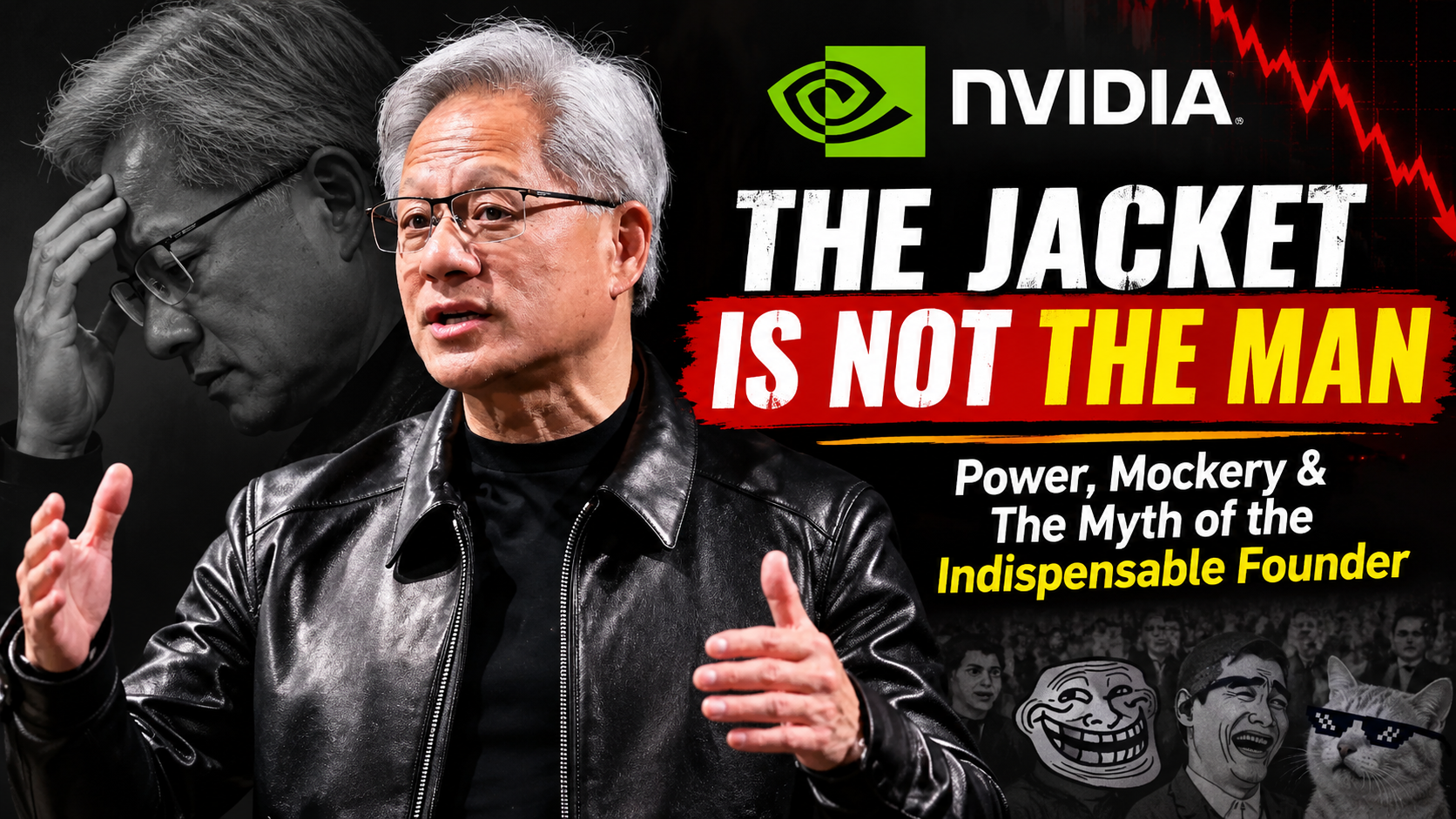
Reporting current as of November 12, 2026. This story is still moving. Where a claim rests on anonymous sourcing or hasn't been confirmed by the people involved, I say so.
On the morning of November 12, a company worth roughly four trillion dollars announced that the man who had run it for 33 years was gone. There was no farewell keynote and no gentle phrase about "pursuing new opportunities." The board's statement said Jensen Huang had resigned as president, chief executive and director, effective immediately. His chief financial officer would take over, and the board would start looking for a successor.
Within hours, the stock was down about 10%, and the internet was already doing what it does.
If you only looked at the memes, you'd think this was a story about a rich man's bedroom. If you only looked at the stock chart, you'd think it was a story about a missing genius. Both readings are too small. The more interesting story sits in the gap between them: what, exactly, were people laughing at, what were they right to be angry about, and why did it take a scandal to make us notice how much power one person held?
First, what is actually established
A good deal of what circulated this week was wrong, so it's worth being strict about categories.
Confirmed on the record. Huang resigned. Nvidia's own announcement and its regulatory filing both say so. The filing lists November 11 as the date the board accepted the resignation, with the public announcement coming on the 12th. Colette Kress, the CFO since 2013, is interim CEO while keeping her finance role. Harvey C. Jones was named the board's first-ever chair. Nvidia reports quarterly earnings on November 17.
Confirmed by Huang himself. On November 8 he emailed all staff and admitted an affair. NBC, which obtained the memo, quotes him saying he was unfaithful to his wife and that there was no excuse for it. He did not name the woman. The same day the board announced an independent investigation, led by independent directors and outside counsel, and said it had no reason to believe national security or Nvidia secrets had been compromised.
Reported, but not proven. The New York Times reported on October 29 that U.S. officials had focused on Alice Huang, a former executive at Megaspeed, a Singapore-based Nvidia customer. The paper said intelligence officers believe she was recruited by China's Ministry of State Security to gather information about Huang and influence his thinking on chip exports. The two aren't related, despite the shared surname. China's foreign ministry called the allegation unsubstantiated. President Trump said Huang told him he did not know she was a spy. I couldn't find a public statement from Alice Huang herself. No charges have been reported against her or against Huang. It's also still unclear whether any sensitive information was ever shared.
Reported by anonymous sources, unconfirmed. On November 11, the Times, citing five former Nvidia employees, reported a second relationship, with a senior executive who reports to him. Nvidia and the executive didn't respond to requests for comment, and according to the Times, Huang told its reporter he shouldn't be talked to directly before hanging up. I've deliberately left that executive's name out of this article. The allegation hasn't been confirmed by either person, and she hasn't had a chance to answer it in public.
Unverified or false. A viral claim that Huang has no prenuptial agreement and faces an $81 billion divorce has not been verified, as even the outlets repeating it admit. A widely shared image of Huang in a heavily studded leather jacket is AI-generated.
A quick word on how I checked this. Several of the biggest outlets, including the Times, the Journal, Bloomberg and Reuters, block automated readers, so I couldn't open their pages myself. For their reporting I leaned on Nvidia's own announcement and filings, and on outlets that summarized those stories, and I've flagged anything that rests on anonymous or secondhand sourcing.
The speed is the first thing worth noticing
Count the days. The Times story ran October 29. Lawmakers asked for a closed-door briefing in the first week of November. On November 8, Huang apologized and the board opened an investigation while expressing confidence in him. A Nvidia spokesperson said he was committed to continuing as CEO without interruption. Three days later, the board was meeting to decide whether to remove him, and a day after that, he was out.
What changed between "full confidence" and "resigned immediately"? Nvidia hasn't said. The public record doesn't point to a finding that secrets were stolen. The board's last public position was that it had no reason to believe so, and the investigation, led by the law firm Wachtell Lipton according to reports, had barely begun. What did arrive in between was the second report, the one about a subordinate, along with a Republican senator calling for his resignation, threats of subpoenas from the House China Committee, and a shareholder lawsuit alleging investors were misled.
I'll offer this as inference, not fact: the board may have moved less because of the spy question, which is still unresolved, and more because of the workplace question, which is the kind of thing boards understand and act on quickly. A relationship between a CEO and someone who reports to him is a governance problem no matter who the other person is. It raises questions of consent, favoritism, retaliation and what employees can safely say. It's also the sort of thing that's hard to defend later in a deposition. Whether that is what actually tipped the board, only the board can say.
What the jokes were really about
Now to the part people keep calling "public humiliation."
The mockery was fast, creative and, in places, very funny. There was a Coldplay kiss-cam riff, a "divorce lawyers right now" meme, a flowchart titled "How To Tell If Your GF Is A Spy," and a LinkedIn banner reading #OpenToWork. The leather jacket, his trademark, became "evidence." Wallstreetbets made a distracted-boyfriend edit over a stock chart.
It's tempting to treat all of this as one thing, either harmless fun or a pile-on. But it's at least three different things.
Mockery of the private act. Most of the humor aims at the affair itself, and much of it uses his wife as a punchline. This is the cheapest kind. Infidelity is a private wrong between people who, in this case, have said little in public. The jokes carry no information. They just let a lot of strangers feel superior for an afternoon. Huang apologized to his family in plain language. Whatever you think of him, a few billion impressions on his marriage do not add up to accountability.
Mockery that smuggles in something uglier. Some of the humor fused "spy" with ethnicity. One widely shared post asked, with a smirk, whether dating a Chinese woman was now illegal. That joke works only if the audience quietly accepts that a person's background is a red flag. Alice Huang is, in the public record, an alleged intelligence asset according to U.S. officials cited by the Times, and nothing more has been established in public. The jokes about her show how quickly an allegation becomes a stereotype. Jensen Huang himself is Taiwanese-born, and it would be naive to think he's exempt from the same reflex.
Mockery as pressure valve for legitimate unease. This is the category people tend to dismiss, and I think it matters. A real share of the laughter was a way of saying something people found hard to say straight: the person who decides how the world's most important chips get distributed may have been compromised, and nobody in a position to stop it appears to have acted. The Times reported that senior officials were warned about Alice Huang before this month, and Forbes, summarizing the Times, says Trump was briefed last year and took no action. Axios reported a classified memo reached the Commerce Secretary. Those are allegations about the government, not just about a CEO. Jokes about a spy scandal are, partly, jokes about institutions that appear to have noticed late.
Here's the sorting rule I'd propose: mockery that stays on the private act is noise, and criticism that stays on conduct, power and process is signal. The trouble is that the internet does not sort. It rewards whichever version is shareable, and the shareable version is the one with the leather jacket.
Why the fall feels so steep
Huang wasn't just a CEO. He was a character. The black leather jacket, the stage-patter, the founder who ran a Denny's-era startup into the center of the global economy, the tattoo of the company logo. For many engineers and gamers, he was the rare executive who seemed to like the actual product. Tim Sweeney, of Epic Games, called ousting him an "Apple firing Steve Jobs level of idiocy" before the resignation. Hugging Face's CEO called it a sad day for developers and "all humanity," and Elon Musk said it would be an honor to hire him.
That's a parasocial relationship, and it has a built-in trap. The more people feel they know a public figure, the more personally they take his failures. Admiration turns to betrayal, and betrayal wants a ritual. Mockery is that ritual. It lets a crowd that felt close to someone declare, loudly, that they were never really fooled.
There's also a simpler engine at work: money. Forbes put his net worth around $155 billion this week, and nothing powers a meme like the image of a very rich man being brought low. But notice the asymmetry. His fortune is mostly Nvidia stock, and Nvidia stock has fallen about a fifth in two weeks, with Huang still holding about 3.6% of the company, according to the Journal. The joke that he is "losing half his money to a divorce" and the fact that he has lost billions on paper in other ways are the same story told in different tones.
The harder question: was he ever that indispensable?
This is where I want to push against the popular narrative, in both directions.
The defenders' case, argued loudly by Sweeney and others, is that Nvidia without Huang is a different and lesser company. There's something to this. Analysts warned of a possible 20% drop on his departure, Bernstein halved its price target from $400 to $200, and one fund executive called the lack of a succession plan a reason the stock was "uninvestable." Markets, at least for a day, agreed that he was hard to replace.
But look at what that argument concedes. If a company worth $4 trillion has no ready successor, no independent chair until this week, and a board that one outlet described as usually deferential, then the problem was never just one man's behavior. It was a structure that made one man's behavior a systemic risk. Nvidia named its first-ever board chair in the same press release that announced his exit. For 33 years, the person running the company also sat on its board with no independent chair above him. That worked while things were going well, which is exactly when governance is hardest to improve and easiest to ignore.
The critics' case, that the genius myth is overblown, has its own weakness. Nvidia's rise rested on real, long-horizon bets (CUDA, the data-center pivot, AI infrastructure) that were widely doubted when he made them. You can believe that and still believe that admiring a founder's judgment about chips gives you no information about his judgment about people, risk or boundaries. Skill in one domain isn't character in another. The most dangerous version of hero worship is the one that treats it as if it were.
Questions the moment should force
On chips and China. Huang has been one of Washington's loudest advocates for loosening AI chip exports to China, arguing that restrictions backfire. Senators from both parties, Elizabeth Warren and Jim Banks among them, warned him in 2025 about a China trip and about firms tied to the Chinese state. It would be unfair to treat his policy views as evidence of compromise. Plenty of executives, economists and officials hold them. But the scandal makes it impossible for him, or his successor, to say those views are just business. The Times reports that the alleged goal of the recruitment was precisely to nudge his thinking on exports. Whether it worked is, again, unproven. That the question can now be asked at all is a cost to every future argument Nvidia makes in Washington.
On Megaspeed. The company bought nearly $5 billion of Nvidia chips. Megaspeed denies wrongdoing, and Nvidia has said it found no evidence of diversion. The Information reported a far larger figure of chips reaching Chinese companies, and the Times reported that the Justice Department is involved. Those numbers are reports, not findings. Until the investigation produces something public, this is the part of the story where "we don't know" is the only honest sentence.
On the board. A board that said "full confidence" on a Sunday and removed its CEO by Thursday either learned something decisive in between or reacted to pressure. Shareholders deserve to know which. If it was pressure from politicians, that is a precedent. If it was new information, they should say so.
On employees. Lost in the market commentary are the people who work there. A company meeting is scheduled for November 18, the same day Huang had been asked to appear before lawmakers, per a report relayed by PC Gamer. If the reporting about a relationship with a direct report is accurate, then people in that reporting line spent months, perhaps years, in a situation nobody asked their permission about. That deserves more attention than the memes about his wife.
What the internet got right, and what it got wrong
Give the crowd some credit. Speculation online was faster than the institutions in at least one respect: the instinct that "the board has confidence in him" was a thin reed. Prediction markets put his odds of leaving by December 1 near 80% on the day the second report landed. Public skepticism of boardroom reassurance turned out, this time, to be justified.
But the crowd also made familiar mistakes. It spread an AI-fabricated image as if it were a photograph. It repeated a divorce number nobody had verified. It treated an allegation about espionage as a verdict, and then folded ethnicity into the punchline. And it made a woman who has said nothing in public, and another whose name appears in only one anonymous-sourced report, into characters in a joke.
None of this means the mockery should have been restrained by some tone police. Power has always been mocked; satire is one of the few tools ordinary people have against people with billions. The better test is simple. Does the joke tell you something true about what the powerful person did with his power, or does it only enjoy his humiliation? Satire of the first kind is a civic good. The second kind feels like justice and delivers none.
What this reveals
Three things, I think.
First, reputation built on competence is brittle in a specific way. It is strong against the kinds of attacks that competence can answer, such as a bad quarter or a failed product. It is weak against the kinds that competence cannot, such as a lapse in judgment about people. Huang's reputation was so completely tied to his genius that when the evidence turned toward his conduct, there was nothing else holding it up.
Second, the founder-as-institution model is a loan, not an asset. It borrows against the future. The terms look generous until the day the founder becomes the risk, and then the interest comes due all at once. Nvidia's board did what boards almost always do: it acted late and under pressure, rather than early and on principle.
Third, and least comfortably, the audience is part of the system. We built the myth. We reposted the jacket, praised the keynote, treated a chief executive as a cultural hero, and made his company's stock a proxy for the future. Then we turned on him in a weekend. Both reflexes come from the same place, a wish to find a single face for forces too large to understand. That wish makes heroes and it makes jokes, and it is poor at making accountability.
A closing thought
Jensen Huang apologized for what he did to his family. Whether the other allegations are true isn't yet known, and the people best placed to find out, the investigators, the lawyers and perhaps Congress, have only started. The company will go on. It has a capable interim chief, a first independent chair, a huge product pipeline and an earnings report in five days.
What won't go back is the illusion that a single person's brilliance is a substitute for oversight. The memes will fade by Christmas. The governance questions should not. If this episode produces only a week of jokes and a leadership reshuffle, we will have learned nothing about power and a great deal about how much we enjoy watching it fall.
The jacket was never the point. It was only the costume. The question is who is watching the person inside it, and what we do when we finally have to.
Frequently asked questions
More to read

How to Turn Website Traffic Into Leads: A Practical Guide for Small Businesses
Turn more of your website visitors into real enquiries without redesigning your entire site. Learn how to identify conversion leaks, improve contact forms and calls to action, build trust, track leads, and respond faster to potential customers.
$ published Nov 12, 2026 · 17 min read · #small-business-marketing #answer-engine-optimization #technical-seo #small-business-seo #beginner-seo
 Malik Asghar

This 32MB AI Voice Model Runs in Your Browser. Could It Replace Cloud-Based Text-to-Speech?
Underdog’s new Woof model squeezes English text-to-speech into a 31.7 MB browser download. We separate the verified facts from the marketing, look at the license, and ask whether it can really replace cloud speech services.
$ published Nov 6, 2026 · 11 min read · #ai #ai-voice #on-device-ai #open-weight-models #text-to-speech
Hanzla Baig